

Higher education has extraordinary stories to tell. So why do so many university advertisements end up saying the same thing? The University of Hull's 30-second film offers a timely reminder of what happens when we stop trying to say everything and start trying to mean something.
CRHEATE's conversation below with Alexander Simpson, Senior Creative Manager, gets to the heart of the story.
But first, I have a confession to make.
When I see something described as a new university advertisement, my expectations aren't always particularly high. I can usually guess what's coming.
A drone shot of the campus. Students laughing over laptops. Researchers looking earnestly at test tubes. A lecturer writing something complicated on a glass wall. Another group of students walking purposefully through an impressive building.
All accompanied by a voiceover telling us about excellence, innovation, opportunity, community, world-changing research and, inevitably, a few league table positions.
Sometimes, if we're lucky, it's all over in two minutes.
And at the end of it, what do we remember?
Be honest … not much, usually.
Now, before anyone starts composing an indignant email, I'm not suggesting these films are worthless, far from it. A good institutional film can be enormously useful. It can help people understand who you are, what you stand for and the extraordinary breadth of things you do.
But I wouldn't call it an advertisement.
I'd call it a manifesto film.
And the distinction matters.
Because advertising isn't about telling people everything you want them to know. It's about making them care about something they might otherwise ignore.
That requires a different way of thinking.
It requires an identifiable audience, an insight into what matters to them, a proposition that connects with that insight and a creative idea powerful enough to get noticed and remembered.
It also requires something that's often surprisingly difficult for universities.
Leaving things out.
The enormous opportunity we’re missing
Higher education has a huge, largely untapped opportunity to use advertising to build awareness, change perceptions and inspire engagement. Not just with prospective students, but with employers, researchers, philanthropists and communities. Sometimes millions of people. Sometimes just a handful who matter.
Yet despite decades of evidence about what makes advertising effective, universities still seem to believe that saying more makes them more persuasive. The result? A sector full of institutions claiming to be distinctive while looking and sounding remarkably alike.
Which is why the University of Hull's 30-second film stopped me in my tracks.
Somebody had actually made an ad.
And a rather good one.
Six weeks to make something worth watching
The story behind Hull's advert begins, appropriately enough, with a media opportunity.
The university's media partner had identified an attractive national television slot during Love Island. The audience was a strong fit with the prospective undergraduates Hull wanted to reach.
There was just one snag. The slot was six weeks away.
Alexander Simpson, who helped lead the creative development within Hull's in-house marketing team, remembers the conversation with Director of Marketing, Catie Winter.
"We can definitely do it. We can fill it with something," he said. "But really we should only do it if we can do it properly."
That distinction between filling a slot and creating something worthwhile is important.
Hull already had plenty of footage. Like every university, it had an extensive library of material that could be assembled into a respectable-looking film. Indeed, following an earlier brand relaunch, the team had done exactly that, producing a shortened television version of a longer institutional film.
"I don't think it really said anything to anyone beyond we are a place that exists," was Alexander's verdict.
Ouch.
But how many university marketing teams, if they're being completely candid, might say something similar about work they've produced?
The problem isn't a lack of talented people, good intentions or production expertise. It's that a collection of impressive things isn't necessarily a compelling idea.
This time, Hull decided to do something different.


A proposition. Imagine that.
The university had recently repositioned its brand around Freethinking Future Makers.
Like many university brand platforms, it encompassed a range of ambitions, characteristics and values. The temptation might have been to create a film that demonstrated every aspect.
Instead, the team made a choice.
They focused on community and developing a new generation of freethinkers. More importantly, they stopped thinking primarily about what Hull wanted to say about itself and started thinking about what a prospective student might want to hear.
Alexander described the shift rather neatly.
"Universities can be guilty sometimes of being a bit too 'come to us, we've got all the answers'."
What Hull wanted to communicate was something different.
Students aren't simply passive recipients of the university's knowledge and expertise. They have something to contribute. Their ideas matter, and ultimately, they'll be the people who go out into the world and make things happen.
It's a subtle shift, but a significant one.
From look what we've achieved to imagine what you could achieve.
That's a proposition and a much more interesting starting point for advertising than a list of institutional accomplishments.
The writing was led by Hull's in-house copy editor, Chris (a poet in his spare time) and, according to Alexander, a driving force behind much of the university's brand voice.
Following several drafts, Chris, Alexander and Catie came together to refine the script. And that’s when the breakthrough came:
"Want to change lives? Start with yours."
Seven words.
No rankings, teaching awards, or graduate employment statistics. Just a thought that connects the ambition to make a difference in the world with the very personal decision to go to university.
I suspect those seven words will stay with a prospective student longer than a list of seven reasons why an institution thinks it's excellent.
The courage to do less
There's something else I admire about this campaign.
Its restraint.
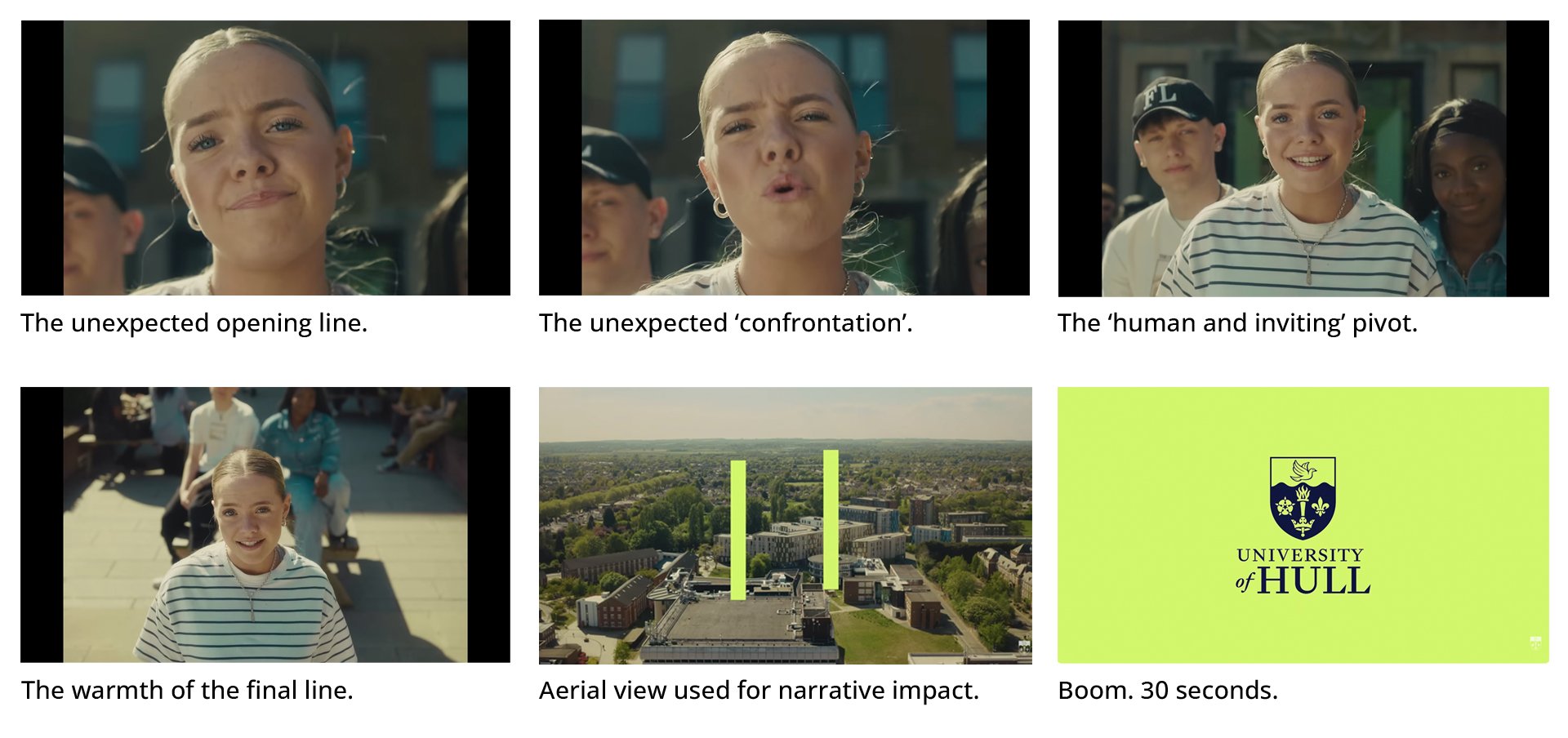
The advert centres on one student, speaking directly to camera. She challenges the viewer, questions the assumption that universities have all the answers and gradually reveals a more optimistic, empowering perspective.
As the camera moves back, two other students come into view. One individual grows into a sense of community. The camera continues its journey until the wider campus is revealed.
One performance. One continuous shot. One idea.
It's a beautifully economical piece of communication.
And that economy isn't simply aesthetic. It serves the strategy.
There's no montage of facilities competing for attention. No attempt to demonstrate the breadth of academic disciplines. No awkward effort to squeeze in a dozen messages so that every part of the institution feels represented.
Just the confidence to decide what matters most to this particular audience, at this particular moment. That can be a brave decision in a university. Especially in an organisation where so many people have a legitimate interest in how it's represented.
But advertising has always involved making choices, and every additional message comes at a cost to the one you most want people to remember.
You can communicate more information in 30 seconds. But you can't necessarily communicate more meaning.
I say “hats off” to that decision.


Authenticity isn’t a camera setting
One of my favourite details about the campaign is how Hull found its lead performer.
Faced with the prospect of creating a national television advertisement, there was an inevitable discussion about using a casting agency.
Alexander wasn't convinced.
"If we're offering drama courses but then we're saying we've got no one that can front a TV advert, why are we running those courses?"
An excellent question.
So they went looking for talent within the university.
Students were invited to submit audition recordings, using a script from an earlier Hull advertisement. The team deliberately withheld the original film so applicants wouldn't simply imitate the performance. Several promising auditions came in, but nobody quite captured what the team wanted.
Then, five minutes before the deadline, Lottie's recording arrived.
"We've got it, she's perfect." the team said.
And I agree, she is.
One of the most impressive things about the finished film is the quality of her performance.
It opens with attitude and an opening line you’d least expect from a Uni: “What’s the point?” She's direct, challenging, almost confrontational.
But watch her face.
At around 10 seconds, her expression softens. Not into an exaggerated advertising smile, but into something warmer, more human and inviting.
The change is tiny. Its effect is enormous.
Suddenly, what began as a challenge feels like an invitation.
It's the sort of detail that's easy to overlook when evaluating creative work, yet it's precisely these nuances that determine whether an audience connects with what they're seeing.
And here's the lovely part.
Lottie is a Hull student.
The performance feels authentic because it is grounded in something authentic. A university that wants its students to believe they can do extraordinary things has allowed one of them to front a national advertising campaign before graduating.
Now that's a story worth telling. And notice that the advert doesn't need to tell it.
The difference between looking authentic and being authentic
There's a fashion in parts of higher education for assuming that if something looks as though it's been shot on a phone, it must be authentic.
Sometimes that's exactly the right creative approach.
But production values and authenticity aren't opposites.
Hull's advert is well crafted. The photography, lighting and camera movement are all carefully choreographed. Its single-take approach looks effortless, which is generally a reliable indication that a great deal of effort has gone into it.
Slate and Mortar Ltd, the production company responsible for bringing the film to life, had to manage the choreography of multiple performers and a complex drone movement. The final result required considerable precision, but still feels natural.
That's the achievement.
It doesn't look like a university desperately trying to be down with the kids. Nor does it feel like a corporate film dressed up as an advertisement. It feels like a young person with something to say.
Which is precisely what the creative idea needed.
Advertising works. But only if we let it.
There's a broader point here. Advertising isn't simply a way of distributing information. At its best, it builds memories, creates associations, changes how people feel and makes brands more likely to come to mind when a decision needs to be made.
Decades of effectiveness research, including Les Binet and Peter Field's influential work on long-term brand building and short-term activation (The Long and Short of It), has demonstrated the importance of creativity, emotion and consistency.
Of course, universities aren't supermarkets, car manufacturers or banks. Their audiences, decision-making processes and measures of success will be very different. But people don't stop being people when they start considering higher education.
They still notice things that surprise them.
They still respond to stories, emotion and humour.
They still forget most of what they're told.
And they still form impressions of organisations long before they're ready to make a decision about them.
That's why I believe the opportunity for universities is so significant.
But it requires a change in mindset.
Instead of asking, " What do we need to tell people?”, start by asking, “What do we want people to remember?”
Instead of insisting that every communication reflects the full complexity of the institution, we might permit ourselves to focus on one thing that genuinely matters to one audience.
And instead of judging creativity primarily by whether everyone internally is comfortable with it, we might consider whether anyone externally will notice it.
That last one may be the hardest.


What happens next matters more than the 30 seconds
What I found particularly encouraging in my conversation with Alexander was that the advert reflects a wider change in how Hull is approaching communication.
The team has also challenged the conventional prospectus, recognising that much of its content is practically interchangeable with those produced by other universities.
Rather than simply repeat the familiar formula, Hull developed a magazine designed to help prospective students navigate questions that actually matter to them. Student finance, university life, the social value of higher education, even the question of whether going to university is the right choice in the first place.
Again, the shift is from telling people about the institution to creating something genuinely useful for the audience.
In classic advertising parlance, “What problem are we solving for the audience?”
The same thinking is influencing how the team approaches its website and experiments with advertising across social platforms.
And that's where things become particularly interesting. Because a genuinely distinctive brand isn't built through one good television advertisement. It's built by making clear, consistent creative choices over time.
Hull now has an opportunity to develop the thinking behind this campaign into a recognisable and coherent way of communicating.
That doesn't mean repeating the same advert endlessly, but finding new ways to express the same underlying proposition, while making each communication relevant to the target audience.
This piece has proven to be creatively distinct and commercially effective. So for me this all demonstrates something higher education could use more of.
The discipline to identify an audience
The confidence to make a choice
And the creativity to make that choice matter
Perhaps we should stop making university ads for universities.
Now, here's a thought.
Maybe one reason so much university advertising looks the same is that, somewhere along the way, we've forgotten who it's for. When creative work has to satisfy dozens of internal stakeholders, it's hardly surprising that it ends up trying to say dozens of things.
Everyone gets a moment.
Every department gets a shot.
Every institutional achievement gets a mention.
And the audience gets a film that asks them to remember everything, which usually means they remember nothing.
Hull has taken a different approach. There are of course, many other good examples, some I have reviewed before.
But this one has a clear target audience, concise proposition, simple creative idea, beautifully scripted and executed. And a superb real performance by student Lottie.
Thirty seconds that know exactly what they're trying to do.
I find that genuinely exciting.
Because if universities can create this sort of communication for prospective undergraduates, imagine what they could do with the remarkable stories they have to tell about research, innovation, partnerships and their contributions to society.
Imagine advertising that changed how businesses thought about working with universities. Or made a philanthropist see the possibility of transforming lives. Or helped a community recognise the value of the institution on its doorstep.
The opportunities are enormous.
But we'll only realise them if we're willing to accept that advertising isn't meant to do justice to everything a university does. It's to make something matter to someone.
The University of Hull has given us a rather good example of how to do it. And, for once, it didn't need two, five or ten minutes, a tour of every faculty or a single league table to make its point.
Just thirty seconds.
And an idea.
Dear universities.
Not everything needs to be in the ad.